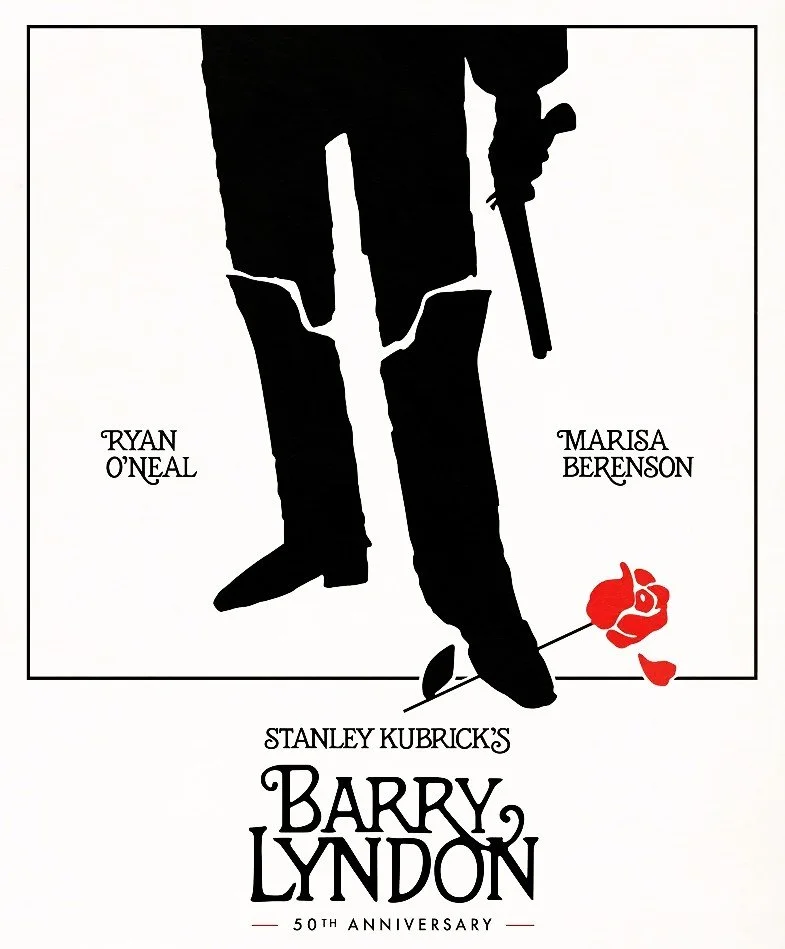
An Essay on the 50th Anniversary of Stanley Kubrick’s Barry Lyndon
By Alexander Larman
18 December 2025
Barry Lyndon at 50
Stanley Kubrick’s films manage to make the viewer do many things. Usually, they take them into a state of awe and terror, a giddy combination that results in a state of near-existential unease on the part of the spectator, even as they consider settings and situations that range from the Roman Empire (Spartacus) and the WW1 trenches (Paths of Glory) to a haunted hotel (The Shining) and the distant future (2001: A Space Odyssey). The films often make the viewer laugh, perhaps uneasily; Dr Strangelove, A Clockwork Orange, Lolita and Full Metal Jacket are all laden with the blackest of black humor, and even his swansong, the Cruise-Kidman erotic odyssey Eyes Wide Shut comes complete with jolts of horror and hilarity at the most unexpected moments. But do Kubrick’s films make you cry?
Most, to be honest, do not, unless you are so overwhelmed by what you’ve just seen that weeping is the only appropriate emotional response. Yet in the case of his 1975 masterpiece Barry Lyndon, there is an extended scene towards the end of the picture that completely turns any conventional idea of Kubrick as a cold and unfeeling filmmaker on its head. The picture’s protagonist, the blackguardly Redmond Barry-turned-man-of-fortune Barry Lyndon, is shy of redeeming features, but he does have two: a remarkable ability to think fast when in a corner (he is often in a corner) and a genuine love of his young son, Bryan.
Yet Barry is a foolish and indulgent father, and so gives the unready boy a horse that has yet to be broken in, resulting in his death when Bryan steals off and rides it unaccompanied. There then follows a section in which the tearful Barry comforts the dying boy by reading him a story which is the most deeply affecting thing that Kubrick ever put on screen: it is all the more moving because it upends any expectation that we have of the character. Barry is a wastrel and a knave, but he is also oddly sympathetic, partly because we enjoy his ingenuity and chutzpah, and partly because those around him — such as Murray Melvin’s sniveling Reverend Runt and Leon Vitali’s brattish, scheming Lord Bullingdon, the eldest son of Barry’s wife Lady Lyndon — are so awful in comparison.
Yet this is Kubrickville (by way, of course, of the adaptation of Thackeray’s original novel), not a place of happy redemption. Barry will get what is coming to him, and the irony is that he’ll get it through a misplaced act of nobility. Offered the chance to kill Bullingdon in the film’s climatic duel, he declines to take it, only to be shot in the leg for his pains instead: a reminder, as if we needed it, that being decent in this hard, cruel world is for suckers.
That, of course, is a lesson that is pervasive throughout Kubrick’s distinguished filmography. With the exception of Spartacus, which is a wonderful picture but also the only film he made that he was purely a director for hire, brought on when Anthony Mann was found wanting by star-producer Kirk Douglas and dismissed, the pictures have the sheer nerveless intensity of the New York chess hustler that Kubrick began his life as being.
Suckers are never given an even break, but patronized, belittled and even murdered; think of Scatman Crothers’ noble Dick Hallorann, the Overlook Hotel’s telepathic cook, who comes back to the hotel to aid Danny Lloyd’s psychic boy in his hour of greatest need, only to be peremptorily murdered by Jack Nicholson’s possessed caretaker Jack Torrance. Or, indeed, Malcolm McDowell’s youthful anarchist Alex DeLarge from A Clockwork Orange, who commits mayhem, suffers at the hands of those who he has affronted, and then ends the picture triumphantly restored to his previous bad eminence, declaring “I was cured, all right!”
Nobody is cured of anything in Barry Lyndon, save perhaps their illusions about love or kindness. The film boasts one of cinema’s great omniscient narrations, delivered impeccably by Michael Hordern, in which the characters are continually undermined or subverted by the gods-eye view of their activities. Kubrick’s pitiless camera observes them on military maneuvers and erotic assignations alike with the same cold contempt, watching as man fails to live up to his promise, over and over again. The film begins with the pointless death of Barry’s father in a duel, shot (in both senses) from afar, and ends with the aftermath of Barry, now a cripple, coming to terms with the sheer pointlessness of all the scheming that he has undertaken.
Perhaps there is a class-based dig to be derived, too. Kubrick lived in Britain for much of his adult life, but was never remotely accepted by British society (any more, admittedly, than he would ever have wished to be). Instead, he was derided as a batshit crank whose films were widely regarded as the products of a brilliant but obsessive imagination, and false stories about the director and his working methods were tabloid catnip for decades. His sense of never wholly being part of his adopted country seems to feed into the way in which Barry is never accepted into the aristocracy, despite the bribes and preferment that he hands out as if they’re confetti, and, when he snaps and publicly beats Bullingdon, he finds himself cast out of society for good, left to descend into a drunken stupor.
Barry Lyndon is a Kubrick picture that never quite delivers what you expect from it. It has all the trappings of period drama, down to Oscar-winning cinematography, using lenses developed by NASA, that captures candlelight on screen better than any picture before or since. But this isn’t elegance for elegance’s sake of the Merchant Ivory (old) school. Instead, it’s as much a sci-fi picture, in its own way, as 2001. Every time I watch it, and there have been many, many viewings, I feel as if I’ve stepped into a time machine for three hours, there to see eighteenth century Europe in all its elegance and barbarity. Every time I’ve watched it, I’ve returned safe but shaken from the journey. One day, I’ll make the trip for the last time, and never come back. And that’s the true delight — and terror — of Kubrick’s masterpiece. Place yourself in his hands, and you’ll never regret it.
Alexander Larman is the author of seven books, most recently LAZARUS: THE SECOND COMING OF DAVID BOWIE, and is the books editor for The Spectator World. He writes about literature, arts and culture for many titles on both sides of the Atlantic, including TIME, The Daily Telegraph, The Spectator, the Washington Examiner and The Critic, where he serves as theatre critic.