An Essay on the 250th Anniversary of Jane Austen’s Birth
By Professor Janet Todd
16 December 2025
Thoughts Arising from Living with Jane Austen
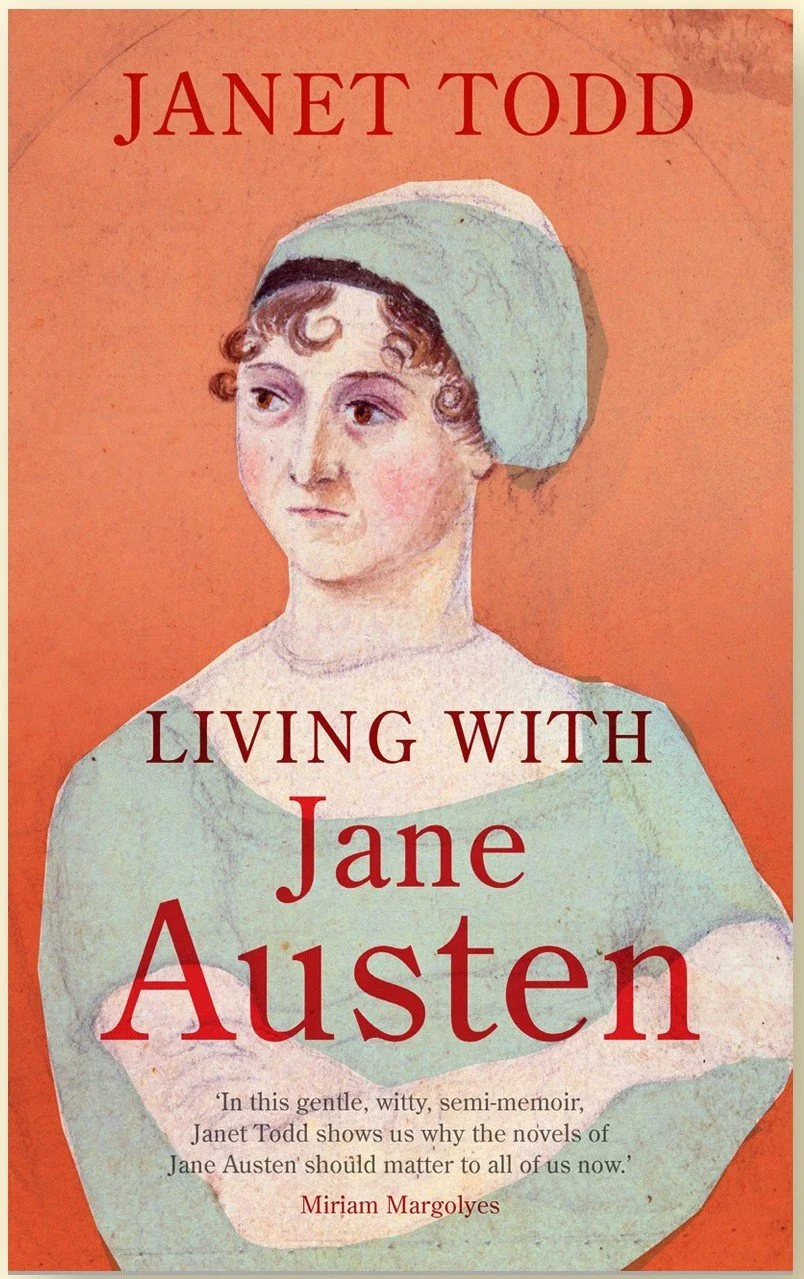
For this anniversary year, I was delighted to provide prefaces and notes for a new 8-volume Cambridge edition of Jane Austen. I also wrote a companion book that is part critical response to the novels and part memoir of my academic life. In Living with Jane Austen I revisited my past through the cultural changes that Austen’s work and I have both witnessed in the USA and UK.
I had an isolated childhood, with no siblings and peripatetic parents. I relished adventure stories such as the wandering novels of Robert-Louis Stevenson and Bulwer-Lytton, as well as comic versions of Walter Scott! Beside these Jane Austen’s romances in family and village settings seemed very tame and claustrophobic.
Now, many decades later, I know how adventurous Austen’s novels are in their own way. For, over the subsequent decades, I have learnt how important family and longstanding friends are in anyone’s life, but how difficult it is to negotiate them well. I was recently at Steventon where Jane Austen was born and lived her formative years. There as a teenager she honed her craft and there she drafted her first three adult novels. Its present isolation brought home to me how much family and surrounding neighbours affected her day-to-day life. In this largely stationary world, people were forced to learn tolerance and restraint. Neighbours might appear objectionable, but, since you had to spend the next year with them and the next, best be polite. Now when so many are self-indulgently upset and openly angry, I find Jane Austen’s emphasis on surface acceptance and courtesy timely and valuable—although unfashionable.
I changed schools on 13 occasions, then as an adult repeatedly switched jobs in universities across 4 continents. I was always excited about going somewhere new, hitting the open road once more. Now in old age I regard Jane Austen’s communities rooted in place or function no longer imprisoning but endearing, even attractive. A rooted life leads to a close encounter with small things, small happenings. I love the passage in Austen’s most complex and enigmatic novel, Emma, which I quote in Living with Jane Austen for it catches what I am describing. Emma is waiting for her young friend Harriet at the door of Ford’s, the only shop selling clothes and fabrics in the big village of Highbury:
Emma went to the door for amusement.—Much could not be hoped from the traffic of even the busiest part of Highbury;— Mr. Perry walking hastily by, Mr. William Cox letting himself in at the office door, Mr. Cole’s carriage horses returning from exercise, or a stray letter-boy on an obstinate mule, were the liveliest objects she could presume to expect; and when her eyes fell only on the butcher with his tray, a tidy old woman travelling home wards from shop with her full basket, two curs quarrelling over a dirty bone, and a string of dawdling children round the baker’s little bow-window eyeing the gingerbread, she knew she had no reason to complain, and was amused enough; quite enough still to stand at the door. A mind lively and at ease, can do with seeing nothing, and can see nothing that does not answer.
The vision is not socially inclusive. The very poor do not appear: a family with ‘wants and sufferings’ live farther away down Vicarage Lane, and the old man needing poor relief does not appear on the main street. But the village so near London is, nonetheless, not entirely stratified nor unchanging: it includes businessmen and professionals such as the apothecary and lawyer, all shifting in status. We, the readers, see round the frequently blinkered heroine—but I think here, for once we mainly see with her and share her moment of satisfaction.
I have also come to appreciate that Jane Austen is not all about insiders and comfortable family groups. She understands the uprooted, the alien. Fanny Price, the heroine of Mansfield Park, the only novel in which we confront the inner life and experience of a child, now speaks to me since Fanny and I were both uprooted from family at 10 or 11. She went to elegant Mansfield Park miles away in Northampton from her cramped home in Portsmouth, I to a boarding school in the wildest part of Wales 6,000 miles from my parents.
To use Emma again. Because of my lifetime of moving, I’m especially attuned also to the problems of someone trying to be accepted into an established community. In Living with Jane Austen I discuss my sympathetic response to Mrs Elton, usually regarded as insufferable. ‘Mrs E’ enters the village of Highbury from a different class and place, the city of Bristol associated with trade rather than Home-Counties gentility, and is despised by snobbish Emma. The two young women will have to tolerate each other of course but Augusta Elton will always be an outsider. Austen places people firmly, hence the spinoffs in fanfiction and film that take Darcy and Elizabeth to Paris and America or Mary Bennet into a den of London criminals never work for me. In Emma, Mr Knightley and Emma may visit the seaside at Cromer, but they won’t sell up and move from Highbury.
Many critics and readers want Jane Austen to be more openly political in her novels, more aghast at the horrific poverty of her time, more ‘progressive’ in the style of our own era. She was certainly socially aware—she gave quite a decent proportion of her small income to the poor—and, like most liberal women writers, she supported the abolition of African slavery. But she was not our contemporary and didn’t think like us, although the absorptive powers of her novels sometimes persuade us that she does. She existed in a time of well-established party politics and in her poetry she praised Tory politicians (18th and early 19th century political parties do not fit easily onto present ones despite a sharing of names). She also encountered many who held quite different, more radical views. I was struck with this fact when compiling the end notes for the Cambridge edition. Austen’s society and her framework were wider and more varied than I once thought. Beyond politics is religion, the secure ground of her being. Despite the fact that she created so many absurd parsons, the Anglican Church provided Austen’s moral framework—and it sometimes peeps out, as when Marianne in Sense and Sensibility notes that, had she died of a self-inflicted fever, she would have sinned against God, or when the charming Mr Elliot is suspected of Sunday travelling. But Austen is first and foremost a novelist, an ‘imaginist’ to use her word for Emma; she does not write for those who want didactic fiction, either overtly political or overtly religious.
One of the main themes of Living with Jane Austen is the physical aspect of life: the ‘unruly body’. Austen has a bracing attitude to physical and psychosomatic ailments both in her novels and in her personal letters. In Emma, the ebulliently healthy heroine views strictly physical illness—often signified by a ’sore throat’—quite differently from nervous or psychosomatic ailments like headaches, fatigue and low spirits. Emma visits her feverishly sick young friend and is praised by the obsequious vicar angling for her large fortune. Yes, she says ‘My visit was of use to the nervous part of her complaint, I hope; but not even I can charm away a sore throat.’ Crabby Mary Musgrove, the heroine’s younger sister in Persuasion, has only one pre-eminence beside her more beautiful and more intelligent sisters: she boasts that her sore throats are worse than other people’s. Her moaning about her special weakness suggests boredom, energy consuming itself through anger at being, well, marginal, left alone when men are out shooting, young girls are flirting and cleverer women are reading: ‘she had no resources for solitude’. Poor unmaternal Mary, no one likes her. In Austen the reader can always provide a backstory.
Perhaps Jane Austen is so harsh on those suffering from psychosomatic illnesses because she regarded her mother as a hypochondriac, much given to detailing her symptoms. Mrs Austen lived to be 87 where her daughter died at 41. In Sanditon, an unfinished comic novel written during her fatal illness, Jane Austen created a whole town based on those who fancied themselves sick and those who preyed on them for money. Her ridiculous characters have leisure and income enough to make a profession of being ill.
As for Jane Austen herself, her letters mention walking back to health or taking a good dose of rhubarb. Until that final illness of course. In my book I wrote about Austen’s slow decline to death in terms of her love of walking and its sad curtailment:
When Jane was a little out of sorts, she often walked herself into health or enough mental well-being to think herself in health. So it becomes especially poignant that the stages of her final illness can be measured by her inability to try this remedy. Unless the weather were particularly treacherous, she was used to walking every day but, as her disease progressed, mobility declined. The letters make almost unbearable reading as we experience her slowing down, taking fewer and fewer steps.
By the end of 1816 Jane Austen was unable to go the less than two miles to her niece Anna’s house Wyards just outside Chawton. At the close of January the following year, she felt a little better and could imagine walking this distance. By mid-March she’d relapsed though declaring herself ‘quite equal to walking about & enjoying the Air’. She did not say how far she walked: that thermometer of well-being was discarded. She was just ‘walking about’.
She made plans to ride the donkey that usually pulled their little family cart. The donkey is sad proof that Jane Austen, the great walker and promoter of walking, had stopped walking.
In November 2025 I came to the end of a long series of book promotions for Living with Jane Austen. It carried me through more than 20 literary festivals and bookshops. A couple of smaller events stand out: the Daphne du Maurier Festival based in the magical setting of Fowey, Cornwall, and the Llangwm Literary Festival in similarly magical Pembrokeshire. The latter was a community festival that included the whole village; held in a marquee in a field with cows and sheep, it seated the front row of the audience on bales of straw. Local inhabitants manned the doors, made coffee and organised the sound system and entry tickets. But, if the festival was charming, the journey to Llangwm was not: the tube in London broke down, the first train from Paddington was cancelled, and the next had multiple attacks of points failure before stopping definitively in Swansea. From there I had to take an expensive taxi across South Wales to arrive (late) for the first event. While in Llangwm I started telling my sorry traveller’s tale to a man waiting inside the marquee, only to discover he was the next speaker, the famous explorer Colin Thubron. He’d come to talk about his adventures along the distant Amur River between Russia and China!
Other events were made special by location, such as one at the London house of Dr Samuel Johnson, whom Jane Austen admired for both his prose style and moral outlook. Before the event, I had a quiet time alone in Johnson’s room with his books and writing desk and could think about the relationship between these two great writers who never met. The second event was in the baroque setting of the Royal Hospital, Chelsea. The place is unrelated to Jane Austen, but, before I wrote on Austen’s life, I was the biographer of her predecessor, the supremely talented Restoration author Aphra Behn, who makes an appearance in my Austen book—both authors love and engage with wit in women, and both in their fiction describe its pitfalls in a patriarchal society. The gilt and plush room where I gave my talk was full of portraits of royal and aristocratic men and women to whom Behn had dedicated poems and plays, some quite disreputable. The hyperbolic dedication was a mode and we cannot know what Behn actually thought of those she outrageously flattered. Her situation a little resembles Jane Austen’s with the Prince Regent, a man she deplored for his extravagant lifestyle and scandalous treatment of his wife, but to whom well-wishers persuaded her to dedicate Emma. The dedication was appropriate, for the Prince was an admirer and was said to keep a copy of her works in his several residences, but its exaggerated repetitive diction feels just a little tongue-in-cheek:
To
HIS ROYAL HIGHNESS
the Prince Regent,
This work is,
By his Royal Highness’s permission,
Most respectfully
Dedicated
By his Royal Highness’s
dutiful
and obedient
humble servant,
THE AUTHOR.
Finally, I must mention my appearance at the Cheltenham Literary Festival. The event was held in an immense hall of nearly 1000 people and I was onstage with my old college chum, the hugely popular actress, Miriam Margolyes, who had agreed to interview me. Given her ability to charm and move an audience, it was gracious of her to make this my show—while lending it her magnetism. Onstage, Miriam suddenly announced that she didn't actually like Jane Austen! Her hold on her audience was such that this Janeite crowd still applauded her wildly. Her response allowed me a defence of my author—an easy business. Over our many years of friendship Miriam has flatteringly referred to me as the ‘writer’ and herself as only the ‘actress’ (hmmm!). However, I couldn’t help noting that her new book probably sold in a day what my more than 20 titles together sold in my lifetime. This allowed me to recall Jane Austen’s response when she learnt that the popular poet Walter Scott had turned to fiction:
Walter Scott has no business to write novels, especially good ones.—It is not fair.—He has Fame & Profit enough as a Poet, and should not be taking the bread out of other people’s mouths.—I do not like him, & do not mean to like Waverley if I can help it—but fear I must.
The Cheltenham event was a surreal experience: through Miriam I glimpsed what life must be like as a superstar! Jane Austen is now a global one. What would have made of such starling posthumous celebrity? Certainly she craved literary success: she wanted as many (discerning) readers as possible for novels she knew to be outstanding, and she wanted more money. But her letters suggest that she would not have courted ‘celebrity’. Her novels appeared without her name, although, after the first, they declared the writer a published author. Sense and Sensibility came out by ‘a Lady’, but Pride and Prejudice was published ‘by the author of “Sense and Sensibility.”’ Occasionally when she was offered the chance to meet literary celebrities like the famous French novelist and woman of letters, Madame de Stael, she demurred. When Miss Burdett wanted an introduction to her, presumably as an authoress, again she drew back.
However—enough of Jane Austen as an historical person. In my book I do discuss the helter-skelter letters she wrote to her beloved sister but my concern is not with the ultimately unknowable author ‘Jane Austen’ but with the fiction by which she wished to be known. So I end with a paragraph from the afterword of Living with Jane Austen which, I think, sums up my feelings about her wonderful books after many decades of living with them:
Jane Austen’s novels have spread out and round me like rich material, a shot silk of rippling ambivalence, of passion and affection, temperamental undercurrents, neediness and intellectual solitude, confusions clarified, resilience, exertion and stillness—and love (however ironised). You can make sense of a life with many great writers—if there is such a sense—but Jane Austen is better than most for the business. She can’t be used for divination, as some people use the Bible or Virgil’s Aeneid, but if you open any page of her novels, you can find a good sentence—as well as a sign of ‘delightful spirits, and that gaiety, that playfulness of disposition’ she so admired.
You find beauty too.
Janet Todd
Hon Fellow Lucy Cavendish and Newnham Colleges, Cambridge
Emeritus Prof, University of Aberdeen
Janet Todd is the author of many biographies, critical works and novels. She is a former President of Lucy Cavendish College, University of Cambridge, and an Emeritus Professor of the University of Aberdeen. Her most recent works are the revised Aphra Behn: A Secret Life, the novel Jane Austen and Shelley in the Garden and the memoir/criticism, Living with Jane Austen.